
1. What are Forced Narratives?
Forced narratives (aka Forced Subtitles) are elements played in the dubbed file only, when Subtitles and CC are set to "off" in the user's playback settings. When the user activates a full Subtitle or SDH/CC file, the FN does not display.
They reflect plot-pertinent information that cannot be conveyed to the viewer through dialogue alone. This info is, therefore, forced on-screen to ensure the viewer loses none of the intended experience.
Even though Forced Narrative events are created within Originator by translators, they should not be considered elements of the subtitled asset. Forced Narratives events are harvested from the main subtitle file after delivery, meaning that they become a file on their own which plays along the dubbed video.
2. What do Forced Narratives cover?
● On-screen text (burnt-in events, principal photography, speaker IDs)
➔ To be included only if plot pertinent: i.e. two people are talking on the street in front of a pharmacy and we can see the pharmacy sign. If the pharmacy is not plot-pertinent, you don’t have to add a translation of it.
➔ Always give precedence to the most plot-pertinent information. Please see below for overlapping FNs.
➔ The duration of the translation should as much as possible mimic the duration of the text on-screen (still within the minimum/maximum duration time frame)
➔ If the OST is mentioned in the dialogue, do not translate the OST and don’t tag it as FN. For example, you’re working on a documentary and the person being interviewed says “I’m a lawyer” while the OST “LAWYER” comes on screen, only translate the dialogue, not the OST.
➔ Do not add events if the OST is the same in your language, i.e. “New York” remains the same in Italian, so I don’t have to add an event for it.
● Plot-pertinent song lyrics (every single subtitle event), unless the song is dubbed
➔ Only translate/tag as FNs songs if plot pertinent and the rights have been granted.
➔ For animated series and movies, there are high chances that the songs will be dubbed. If the SG is not available, it may be worth checking with the PM whether they know if the dubbing studio will dub the songs.
➔ Always raise a Zendesk ticket when in doubt about song treatment.
● Archival footage (TV, movie, historical, news footage not originally filmed for the title)
● Creative intent (pay close attention to show guide, FN lists, instructions)
● Unintelligible dialogue (even if source and target languages are identical). For example, in Big Mouth, the character Maury is really hard to understand and his dialogue is always accompanied by subtitles to make sure the audience don’t miss anything. The same way of talking will be replicated by the dubbing author, therefore in every language his dialogue will be matched by subtitles (tagged as FNs).
● Foreign dialogue, sign language, “artificial” languages, etc, when different from the primary/source language. If you are working on a German show and someone says something in English, German will be the primary language (that will be dubbed), while English will be the secondary language (that the FN will need to cover)
➔ Only include/tag as FN foreign dialogue that the viewer is meant to understand. For example, in The Queen’s Gambit, Beth goes to Russia to play in a chess tournament and there is a man commenting on it in Russian. That dialogue is meant to be understood by the viewer and therefore should be tagged as FN.
❖ FOREIGN DIALOGUE THAT SHOULD NOT BE TAGGED:
- Foreign dialogue that is then translated by another character.
- Foreign dialogue that the character does not understand, i.e. a character is visiting a foreign country but does not speak the language.
- Random foreign words said within a sentence, i.e. a character speaking in English says, “Hola! My name is Juan”. When dealing with sentences like this, you can decide to leave “Hola” as it is (in that case, you need to italicize it) or translate it into your language (especially if you think that foreign word may not be understood by viewers in your country; if you translate it, don’t use italics)

● Episode titles, when burned in
● Netflix and Translator Credits
● Some bilingual/multilingual shows: refer to show guide
Specific instructions regarding FN treatment are provided in the show guide and other reference materials. If you are not sure whether an element should be tagged as FN or not, please reach out to [email protected]
3. Forced Narratives treatment
Every instance will be different, but the main question you have to ask yourself when dealing with one of the elements above is: “Will the dubbing studio cover this?”. Take a song for example: if we know the dubbing studio is going to dub the song, then we still have to translate it, but we don’t have to tag it as FN; on the other hand, if the dubbing studio is not going to dub it, we need to translate it and tag it, so that our translation can also be shown alongside the dubbing to make sure the meaning is conveyed.
Show guides and other reference materials contain precious instructions as to whether an element should be tagged or not. In cases where no specific instructions are provided, we should assume they need to be tagged.
● How to read a Show Guide
When looking at a Show Guide, it’s important to read both the instructions for Subtitling and for Dubbing.
Should an element (an OST in this case) need to be tagged as FN, this will be specified in the dubbing section.

If you come across instructions like the one below, you still need to translate the element, but don’t tag it as FN (because dubbing is going to cover it).

● Overlapping FNs
Another important topic to discuss is how to deal with FN elements that overlap with audio. Most of the time, this situation will occur with on-screen text overlapping with audio.
Let’s take a look at the screenshot below:

When you overlap an event, you are actually creating two subtitle tracks. Track 1 is the subtitle
track, the main one. Track 2 is the overlapping FN track, which will only be displayed with the
dubbed audio.
When you overlap an FN event, this will only be shown against the dubbed audio track, whereas
a non-overlapped FN event will be displayed with both with subtitling and with dubbing.
In the scene from where the screenshot was taken, the woman is talking while a recipe is
displayed on screen. Both the dialogue and the OST are plot-pertinent, but as subtitlers we
need to give precedence to one of these elements, and most of the times (like in this case),
dialogue has been given precedence, so subtitle viewers will only see the dialogue translation
on screen. They will not see the OST translation.
On the other hand, people watching the dubbed version will be hearing the dialogue, therefore
there’s room to have the OST translation (FN event) displayed on screen.
Whenever overlapping could be avoided, it is recommended to do it. If you have enough
room and time (that is, if the RS allows it) to “squeeze” the FN event between two dialogue
events, please do so, even if the template has an FN overlapped. This way, both people
watching with subtitles and dubbing will be able to read the FN translation. Take a look at the
two examples below:
- With this setting, people watching subtitles will not be able to read the OST translation.

- This way, both people watching subtitles and dubbing will be able to read the OST
translation. This solutions is especially preferred when translating OSTs of speakers’
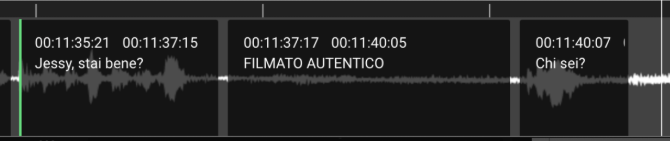
Lastly, please keep in mind that dialogue isn’t always the most plot-pertinent message.
Take the following situation as an example: two people are talking about this and that, not
actually saying anything important. At some point, one of them receives a very important text
message shown on screen. In this case, the most plot-pertinent message is the OST, not the
dialogue. What to do at that point? Omit the dialogue, translate the OST only and tag it as FN.
4. A few things to keep in mind
- An FN element should never be combined with dialogue in the same subtitle. For example: person A says something in English (the primary/source language in this case); person B replies in French, and as per SG the French dialogue is meant to be translated and tagged as FN. The lines said by person A and B can’t be in the same subtitle. They necessarily need to be in two separate events, or the line said by person A automatically becomes an FN as well, but it would be redundant.
- If an episode title appears as OST and is also voiced-over, only translate the voice over and treat it as dialogue. No FN should be applied.
For additional tips on FN reading speed handling, check out this short video!